Small Business Loan Options: Secured & Unsecured Explained
With small businesses accounting for more than 99.9% of all businesses in the United States, a small business loan offers an opportunity for growth for privately owned companies across the country.
Whether you’re starting a new venture or scaling an existing one, a secured or unsecured small business loan can support your next step.
We’ll break down the basics of secured and unsecured business loans, highlight the pros and cons of each, and explain how to choose the right one for your needs.
Understanding Secured Business Loans
A secured business loan is a type of financing where borrowers pledge assets, such as property, equipment, or inventory, as collateral to obtain funds.
This collateral acts as a safety net for lenders, offering a recoverable asset if the borrower fails to meet repayment obligations.
Although the collateral provides that assurance, lenders typically prefer not to seize and sell these assets, since they often have to sell at a discounted price to quickly recover losses and maintain liquidity.
While secured loans offer appealing borrowing terms, there are pros and cons to consider.
Pros of Secured Loans
- Lower interest rates: Generally, secured loans have lower interest rates because the lender has collateral as a safety net, reducing their risk.
- Longer repayment periods: Payments are more manageable due to longer repayment terms.
- Higher borrowing limits: Since the lender has collateral to fall back on, they may be more willing to offer larger loan amounts based on the value of the asset.
- Access to equity without selling: Secured loans let borrowers put the value of an asset to work without having to sell it, so they can use what they already own while keeping ownership of it.
Cons of Secured Loans
- Risk to assets: If borrowers default, i.e., fail to repay the loan as agreed, they could lose whatever was pledged as collateral.
- Complex approval process: Secured loans can take longer to approve than unsecured loans, since the lender may need to appraise the collateral.
- Additional costs: There may be additional costs involved, such as appraisal fees, legal fees, and other related charges.
Unsecured Business Loans Explained
An unsecured business loan is a financing option that does not require borrowers to provide collateral as a safeguard to the lender.
It is not backed by assets, so the borrower’s property and equipment are not at direct risk in case of default.
However, this increases the risk for the lender, which often means higher interest rates or stricter repayment terms.
While unsecured loans offer easy access to funds, it’s important to weigh their benefits and drawbacks.
Pros of Unsecured Business Loans
- No collateral required: Businesses and individuals don’t put their assets at risk, since the loan doesn’t require collateral.
- Fast approval process: Without the need to evaluate collateral, unsecured loans often have a quicker approval process.
- Flexible use: These loans usually come with fewer restrictions on how you can use the funds, giving you more flexibility.
Cons of Unsecured Business Loans
- Higher interest rates: To compensate for the risk, lenders usually charge higher interest rates compared to secured loans.
- Lower borrowing limits: Given the higher risk to lenders, unsecured loans often have lower borrowing limits.
- Variable approval criteria: Approval criteria for unsecured loans vary by lender. Some offer high-risk products with minimal requirements, while others have stricter conditions.
Secured vs. Unsecured Business Loans
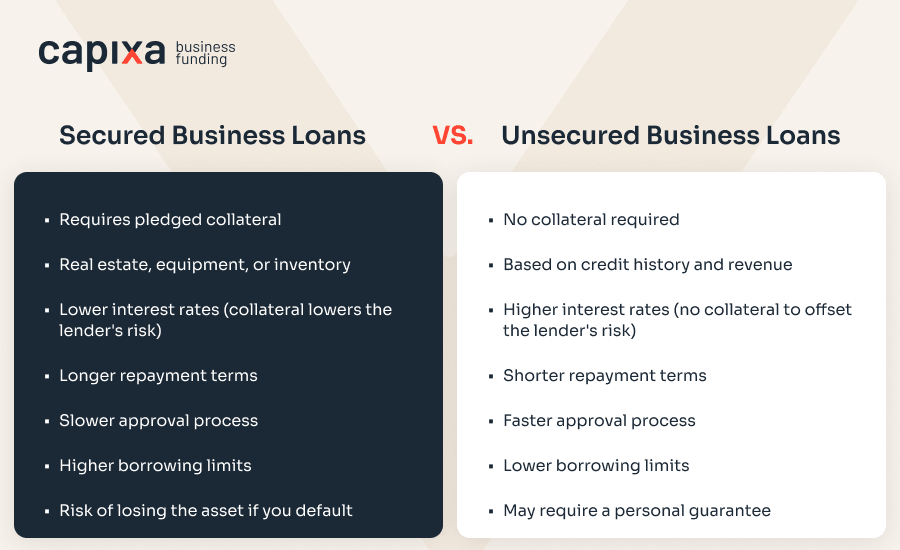
Weighing a secured vs. unsecured business loan comes down to two questions: What are you willing to put on the line, and how quickly do you need the funds?
Collateral Requirements
Secured loans require you to pledge an asset: real estate, equipment, or inventory. It serves as a guarantee the lender can claim if you default.
Unsecured loans don’t require collateral. Approval is based on your creditworthiness and financial history.
Interest Rates
Secured loans may offer lower interest rates as they are less risky for lenders.
Unsecured loans might carry higher rates to offset lender risk.
Loan Tenure
Secured loans often come with longer repayment periods due to the inclusion of collateral.
Unsecured loans typically have shorter repayment terms, since the lender is taking on more risk without an asset to fall back on.
Repayment Structure
Since collateral backs the loan, with secured loans, lenders may allow more flexibility if your cash flow shifts.
For example, a lender might let you defer a payment or adjust your schedule temporarily if you hit a rough patch.
Unsecured loans, on the other hand, tend to follow a fixed schedule with less room to adjust.
Approval Speed
Because there’s no collateral to appraise, unsecured loans typically move through underwriting faster.
Secured loans take longer, since the lender needs to verify and value the pledged asset first.
Borrowing Limits
Secured loans often allow for larger amounts, since the collateral gives the lender a way to recover funds if you fail to repay.
Unsecured loans tend to cap out lower, since approval relies on credit and revenue alone.
How To Choose the Right Business Loan Option
Both secured and unsecured small business loans have advantages and challenges. Here’s how to work through the decision.
Assess Your Business Needs and Financial Health
Look at your financial picture and the exact needs the loan will address.
- Creditworthiness: Most lenders look at your financial history, including past repayments, existing debt, and how consistently you’ve met previous obligations. Read about the reasons why your financing application can get denied.
- Asset availability: Consider what assets you have that could serve as collateral for a secured loan.
- Financial stability: Review your cash flow statements, balance sheets, and financial projections to confirm your business can manage the repayments.
Evaluate Your Risk Tolerance
Risk tolerance shows how much uncertainty your business is comfortable taking on.
- Collateral risk: For secured loans, make sure you’re comfortable putting assets at risk if repayment falls behind.
- Financial risk: For unsecured loans, be prepared for potentially higher interest rates and stricter repayment terms that could strain your cash flow.
Schedule A Consultation With Capixa
Capixa is an investment capital funding company that takes the time to understand your needs and find the best small business loan solution for your business situation.
Our team of business builders, problem solvers, and experienced investors help businesses get small business loans quickly, securely, and on their own terms.
If you’re running a small business across various industries and you’re seeking support, Capixa offers:
- An extensive lender network: We give you various options and tailored opportunities that fit your business goals and current stage of growth.
- Customized terms: Our loan terms are shaped around your business’s unique needs.
- A relationship, not just a transaction: We’re here to support your business over the long run, not just close a deal and move on.
- Guidance every step of the way: Expect clear, ongoing communication and expert advice to guide your decisions.
And if a small business loan isn’t the right fit for your situation, Capixa also offers other solutions.
These include revenue-based financing, business term loans, and a business line of credit, so you have more than one path to the funding you need.
What sets Capixa apart in the competitive financial terrain?
Our business is a blend of expert knowledge, an extensive lender network, and a commitment to developing meaningful relationships with both borrowers and lenders.
Is a Small Business Loan Secured or Unsecured? FAQS
Is a small business loan secured or unsecured?
Small business loans can be either secured or unsecured. The main difference between the two types is that secured business loans require the borrower to pledge assets as collateral. In contrast, an unsecured loan does not require collateral. That lowers the borrower’s risk but shifts more risk onto the lender, which typically increases the cost of capital.
Is it better to use a secured or unsecured loan?
The choice depends on your business’s specific needs, financial health, and risk tolerance. A secured loan might be the better option if you need a larger amount of money and are more comfortable with a longer repayment term. It’s also a good choice if you have assets to leverage and are looking for lower interest rates. An unsecured loan could be more favorable if you’re seeking quick funding without risking assets and if a potentially higher interest rate and shorter repayment period aren’t a concern.
Why is a secured loan riskier than an unsecured loan?
Secured loans are generally considered riskier for the borrower because if the business fails to meet its repayment obligations, they may lose the assets used as collateral, potentially jeopardizing the business’s operations.
Can you borrow more on a secured loan?
Typically, yes. With secured loans, lenders tend to offer larger loan amounts because the collateral mitigates their risk. The value of the assets you’re using as a collateral often affects the amount you can borrow.